By 2026, global tourism will have moved decisively beyond post-pandemic volatility into a phase of structural realignment. The era of “revenge travel” is over. In its place emerges a more disciplined, value-driven and climate-aware travel economy, one that is increasingly decoupled from broader macroeconomic fragility. Despite persistent inflation and geopolitical uncertainty, travel demand continues to expand, growing faster than global GDP and reaffirming tourism as a core lifestyle expenditure rather than a discretionary indulgence.
This global picture is shaped by a clear bifurcation. High-income travellers remain remarkably resilient, sustaining the luxury and experiential segments with little price sensitivity. At the same time, mass-market travel faces margin pressure, pushing price-conscious consumers towards emerging or lower-cost destinations. The result is a global tourism market increasingly divided between high-yield, experience-led travel and commoditised volume tourism struggling to protect profitability.
Climate adaptation is now a market force. Rising summer temperatures across Southern Europe are accelerating demand for “coolcations” in Northern Europe and shifting Mediterranean travel into the shoulder seasons. April–May and September–October are becoming as commercially important as peak summer, fundamentally reshaping seasonality models. Destinations able to extend their operating calendars will gain a structural advantage; those dependent on a narrow summer window will be exposed.
Tourism receipts are expected to exceed €23.5bn in 2026, driven more by rising average spend than by pure volume growth.
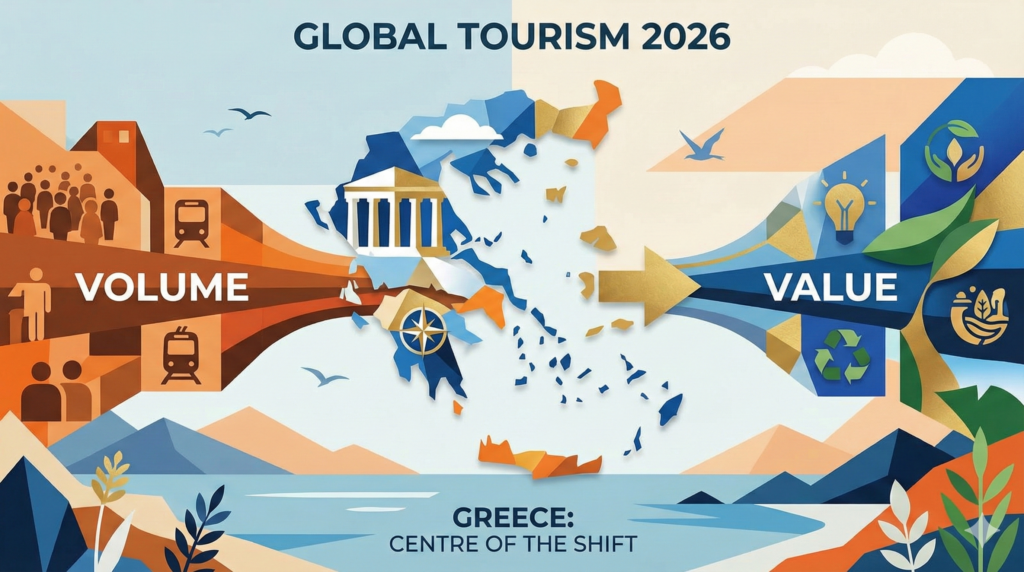
Against this backdrop, Greece enters 2026 at a strategic crossroads. After years of record arrivals and revenues, the country faces what policymakers increasingly describe as a “success trap”: overtourism, infrastructure stress and climate vulnerability. The response is a deliberate pivot from volume to value. Rather than chasing headline arrival numbers, the emphasis is shifting to higher spending per visitor, longer seasons and better regional dispersion.
The numbers remain strong. Tourism receipts are expected to exceed €23.5bn in 2026, driven more by rising average spend than by pure volume growth. Early airline data suggests continued momentum into the winter months, reinforcing Greece’s push toward year-round tourism. Yet this success comes with clear constraints. Labour shortages are intensifying, public infrastructure investment lags behind private luxury development, and water scarcity is emerging as the most acute systemic risk for the years ahead.
Regulation is becoming a defining feature of the Greek tourism model. New cruise passenger fees in saturated destinations such as Santorini and Mykonos aim to smooth visitor flows and fund local infrastructure. Stricter controls on short-term rentals, particularly in central Athens, signal a political willingness to prioritise liveability and housing access over unchecked growth. These measures may constrain supply in the short term, but they also strengthen Greece’s positioning as a regulated, high-quality destination.
The United States remains Greece’s most valuable market in terms of per-capita spend, supported by a strong dollar and expanded airlift.
On the demand side, source markets are evolving. The United States remains Greece’s most valuable market in terms of per-capita spend, supported by a strong dollar and expanded airlift. Asia is returning, with India emerging as a particularly promising long-term growth engine thanks to new direct connectivity and strong shoulder-season travel patterns. By contrast, traditional European markets such as Germany and the UK show signs of maturity, with increasing price sensitivity and competition from lower-cost Mediterranean and Balkan destinations.
Infrastructure will determine whether Greece can convert strategy into sustained advantage. Projects such as the new airport at Kastelli in Crete and the expansion of the Athens metro network are critical, but 2026 will test execution rather than planning. The gap between world-class hotels and strained public utilities remains Greece’s most pressing reputational risk.
The outlook for 2026 is therefore one of managed prosperity rather than unchecked expansion. Greece remains a tourism superpower, but success will increasingly be measured not by how many visitors arrive, but by how well the country manages their impact. In a global industry recalibrating around sustainability, climate resilience and value, Greece’s challenge is clear: to ensure that its celebrated hospitality is matched by infrastructure, labour and environmental stewardship fit for a more demanding era of travel.
Leave a Reply