In the Shadow of Chelidona
There are regions where geography does not merely frame human life but actively shapes it—dictating pace, scale, and silence. Evrytania is one such territory: not simply a prefecture, but a dense alpine interior where mountains impose their own logic on time and movement. At its southwestern edge, where the forested folds of the Pindus descend abruptly into the blue-green waters of Lake Kremasta, a stone-built settlement seems suspended between earth and sky. This is Fidakia.
Reaching Fidakia is not a matter of distance but of transition. The journey begins in Karpenisi, a lively mountain capital, before the road peels away from urban rhythm and enters a narrowing world of fir trees and switchbacks. Eight kilometers along the Karpenisi–Agrinio road, a modest sign at a place known as “Bagasáki” points left—toward silence. From here, asphalt coils tightly through dense fir forest, climbing insistently, each hairpin turn opening fleeting views toward the ridgelines of Mount Chelidona.
The village’s name—Fidakia, “little snakes”—is commonly linked to this serpentine ascent. Yet older theories reach deeper, suggesting linguistic roots connected either to ancient Phthia, homeland of Achilles, or to endemic mountain flora once known locally as fyda. Until the mid-20th century, the village was often written as “Feidakia,” preserving echoes of that ambiguity. Whatever its origin, the effect of arrival is unmistakable: modernity loosens its grip, and the mountain takes over.
Stone and Wind: Life at 960 Meters
Perched at roughly 960 meters above sea level, Fidakia is a rare example of architectural coherence. Officially designated a preserved traditional settlement, it reads less like a village and more like a single organism. Stone houses press close together, forming a compact, almost defensive mass against winter winds and snow. The local grey stone quarried from the slopes of Chelidona dominates every surface, while tiled roofs echo the muted tones of soil and forest.
At the heart of the village lies its square and the Church of the Birth of the Virgin Mary, a 19th-century basilica crowned with a dome.
Cars are left at the edge of the settlement. Inside, narrow cobbled lanes remain intact, and the dominant sound is the measured rhythm of footsteps on stone. At the heart of the village lies its square and the Church of the Birth of the Virgin Mary, a 19th-century basilica crowned with a dome. Inside, a finely carved wooden “iconostasis” crafted by Epirus masters speaks quietly of a past when pastoral wealth and trade sustained life at this altitude.
Today, fewer than thirty permanent residents remain. Yet gardens bloom, shutters are freshly painted, and the village breathes—not as a museum, but as a place where continuity still matters.
The Taste of the Mountain
Hospitality here is inseparable from the land. In small guesthouses and family-run tavernas, the table reflects altitude and season: tsalafouti, the region’s emblematic creamy sheep-and-goat cheese; hand-rolled pies filled with wild greens; slow-cooked lamb and game; spoon sweets preserved in syrup. Meals end with local tsipouro, sometimes infused with forest berries, warming more than the body.
Tsangarakalona: The Balcony of the Agrafa
If Fidakia is the heart of this landscape, Tsangarakalona is its gaze. A gentle three-kilometer walk west of the village leads through fir forest scented with resin and damp earth. The path is unhurried, immersive, until the trees thin and the ground drops away.
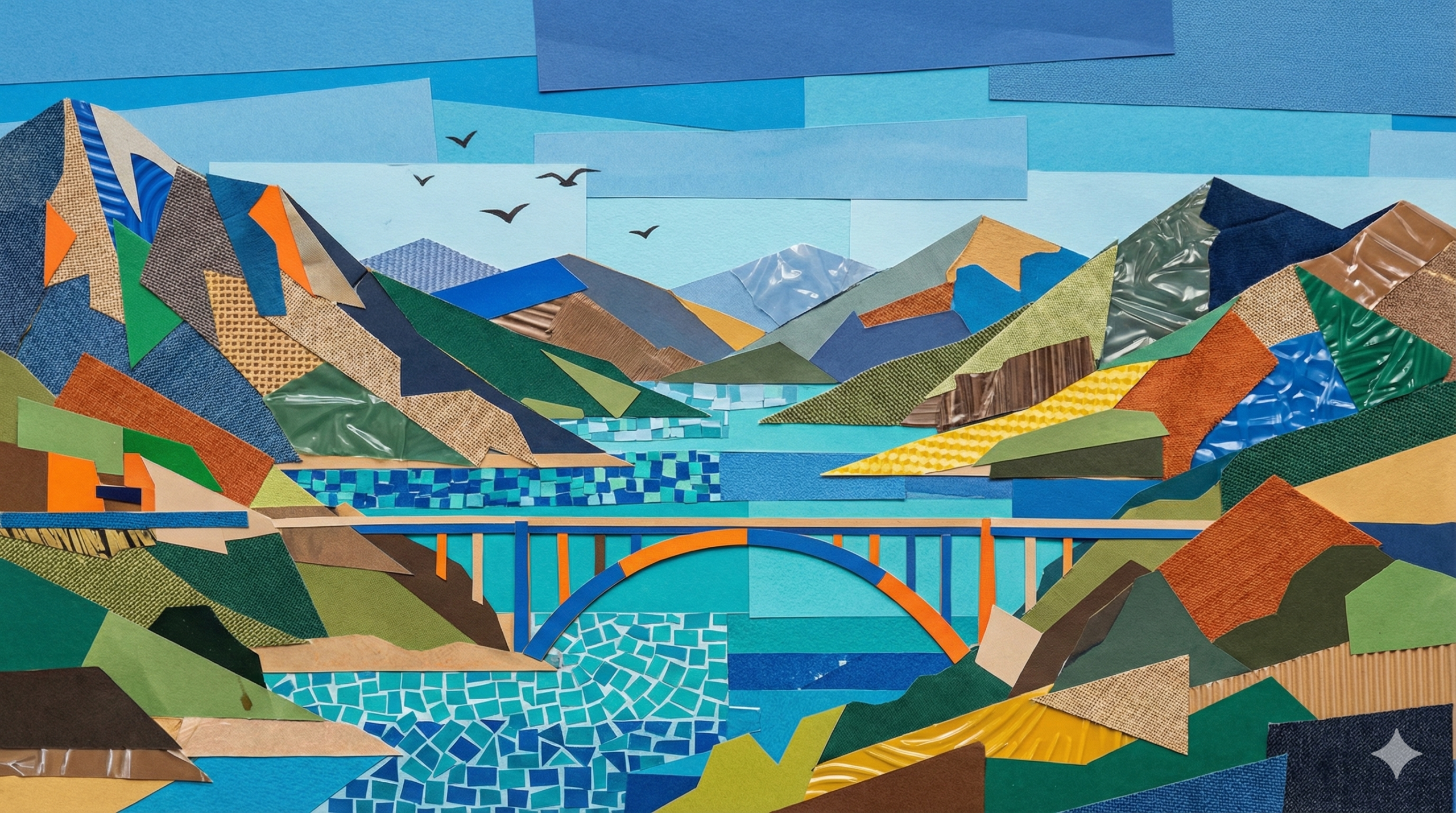
ar below, the modern Episkopi Bridge stretches delicately across the lake, a reminder of human scale in a landscape that resists it.
What unfolds is one of the most arresting vistas in mainland Greece. From this natural balcony, Lake Kremasta reveals itself not as a reservoir but as a labyrinth of fjord-like inlets, peninsulas, and flooded ravines. Light transforms the water constantly—from deep cobalt to muted leaden grey. Far below, the modern Episkopi Bridge stretches delicately across the lake, a reminder of human scale in a landscape that resists it.
The lake itself is a product of ambition and loss. Created in the 1960s by the construction of one of Europe’s largest earth-fill dams, it submerged nearly twenty villages. Beneath its surface lies the old settlement of Episkopi and the shell of a Byzantine church whose frescoes were painstakingly removed before the waters rose. Memory here is not erased, it is suspended.
At times, when water levels fall, the legendary Manolis Bridge reappears: a 17th-century stone arch that surfaces and vanishes with the seasons, a quiet act of resistance against oblivion.
Where Roads End
As dusk settles, Chelidona’s peaks catch the last light, turning copper and violet. The return to Fidakia is slow, reflective. In this corner of the Agrafa Mountains, time is not measured by hours but by water levels, by snowfall, by the reappearance of stone from beneath the lake.
For a traveler, and certainly for a journalist accustomed to mapping the world—Fidakia is more than a destination. It is a reminder that the deepest beauty often lies where roads narrow, signals fade, and silence finally begins.
Leave a Reply