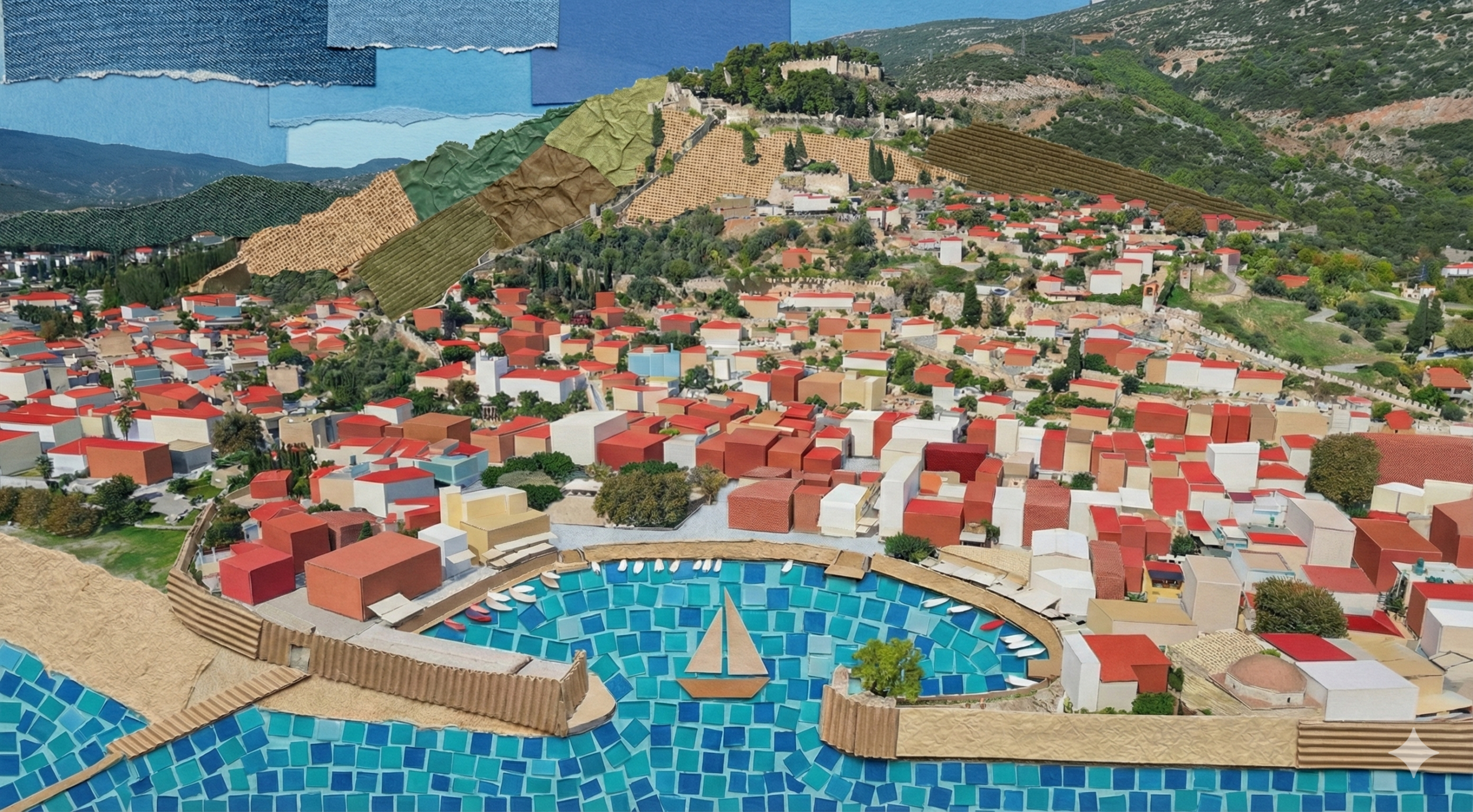
At the narrow throat of the Gulf of Corinth, where mainland Greece seems to inhale before exhaling toward the Ionian, Nafpaktos stands with the poise of an old sentry. It is a place shaped by thresholds: between mountain and water, medieval fortification and contemporary promenade, local routine and the passing drift of travelers. You don’t come here only to “see a town.” You come to read a landscape that has been written and rewritten by empires, by merchants, by sailors, by weather, by appetite.
Nafpaktos is often described as picturesque, and it is. But the word doesn’t quite capture its true character: a castle-town whose stone spine descends toward a Venetian harbor shaped like a horseshoe, creating a natural amphitheater where the sea becomes stage and mirror. In the morning, fishing boats and small craft nudge the water with minimal drama; by late afternoon, cafés and tavernas fill as the light softens, and the harbor’s two stone arms seem to pull the horizon closer.
The Venetian Harbor: A Small Theater of Big History
The harbor is the city’s public heart its most legible postcard and its most lived-in space. Two fortified moles, crowned by towers, guard the entrance. The fortifications don’t sit above Nafpaktos as distant monument; they participate in daily life. Stone textures catch the changing sun pale gold at noon, amber by dusk—while the water holds a second version of the town, slightly darker, slightly more honest.
Near the harbor stands a statue of Miguel de Cervantes, the writer of Don Quixote, wounded at the Battle of Lepanto (1571), a reminder that Nafpaktos, once known as Lepanto, is not only scenic but geopolitically significant. The battle itself is the kind of Mediterranean event that feels simultaneously close and mythic: galleys, alliances, shifting powers, the sea as a corridor of history. Here, it becomes quietly personal—an author’s missing hand turned into a local landmark.
And beyond, almost like a floating parenthesis in the background, the Rio–Antirrio Bridge stretches across the strait modern engineering in conversation with medieval stone. Nafpaktos has a gift for such contrasts. It doesn’t feel torn between eras; it feels layered, like a palimpsest that kept its earlier sentences.
The Castle and Old Town: A Vertical Walk Through Time
To understand Nafpaktos, you need to climb. The castle is among the best-preserved in Greece, arranged in multiple defensive levels that rise above the town like a slow spiral of stone. The ascent is not strenuous, but it is instructive. Each terrace shifts the perspective: the harbor becomes a miniature; the bridge becomes a clean line; the gulf opens like a map. Up here, you sense why this location mattered—how geography becomes strategy.
The old town below the castle is a network of narrow lanes, modest squares, heavy wooden doors, and small courtyards. It has the intimate scale of a place built for walking and conversation, for shade in summer and shelter in winter. Even without any festival gloss, it carries its own quiet choreography: the smell of coffee, the occasional crackle from a fireplace on cool days, laundry moving in the breeze, the subtle hum of residents who do not perform their town for visitors—because they don’t need to.
Stenopazaro: The Social Vein
Close to the harbor, the old commercial passage known as Stenopazaro functions like the city’s connective tissue. It’s where you feel the town’s pulse most clearly: people greeting each other, stopping for a glass of something local, drifting between shops and small bars. It’s not a museum street; it’s a social one—Nafpaktos in its everyday register, informal and fluent.
A Cuisine Between Two Worlds: Sea and Mountain on One Table
Nafpaktos sits with its face to the sea and its back to rugged highlands, and its food reflects that duality. Along the waterfront, seafood is the obvious language: grilled fish, small fried catches, shellfish when the season and the boats allow, lemon and olive oil doing what they do best—revealing rather than disguising.
But the most interesting meals in Nafpaktos often happen when the menu turns inland. The broader region of Roumeli is defined by hearty, practical mountain cooking: slow braises, stews, rich sauces that make sense when evenings cool and the day has been spent outdoors. In and around Nafpaktos, you’ll encounter pies—the signature form of Greek domestic architecture in food—filled with wild greens, cheese, pumpkin, or whatever the landscape offers. In cooler months, local tables lean into comfort: beans, lamb, goat, and—when hunting traditions surface—game cooked with restraint and confidence.
What stands out is the continuity. Even as Nafpaktos modernizes, the underlying culinary logic remains local: what the sea gives, what the mountain permits, what the pantry remembers. Spoon sweets—walnut, quince, sour cherry—still appear as gestures of hospitality, and tsipouro still anchors conversations the way it does across much of mainland Greece.
Beyond the Coast: The Wild Quiet of Mountainous Nafpaktia
If Nafpaktos is your base, the real secret is how quickly you can escape into a different Greece. Drive inland, and the sea disappears behind folds of terrain. Mountainous Nafpaktia is a world of fir forests, chestnut trees, stone villages, and ridgelines that feel unexpectedly alpine. Here, the air changes—cleaner, sharper—and sound seems to travel differently. It’s the kind of landscape that doesn’t demand spectacle; it offers immersion.
Villages like Ano Chora, built amphitheatrically at altitude, make a compelling counterpoint to the coastal town. Their stone houses and shaded squares carry a slower tempo. Trails thread through forests and ravines—routes that can be simple half-day walks or more ambitious hikes depending on season and stamina. Even a brief excursion recalibrates your sense of Greece: this is not the postcard Aegean, but a continental wilderness shaped by elevation and isolation.
Nafpaktos as a Way of Being
What makes Nafpaktos enduring is not a single attraction but a certain balance: history without heaviness, beauty without self-consciousness, gastronomy without theater. It is a town that invites you to move between perspectives—harbor level to castle heights, coastal light to mountain shadow, seafood simplicity to Roumeli comfort food.
In an age when destinations often try to become content, Nafpaktos remains stubbornly real. You can spend a weekend here and feel you’ve rested. You can stay longer and realize the town has started to teach you its rhythm—how to walk slower, look longer, eat more thoughtfully, and let geography do what it has always done in this part of Greece: shape the way you live, even briefly.
Leave a Reply