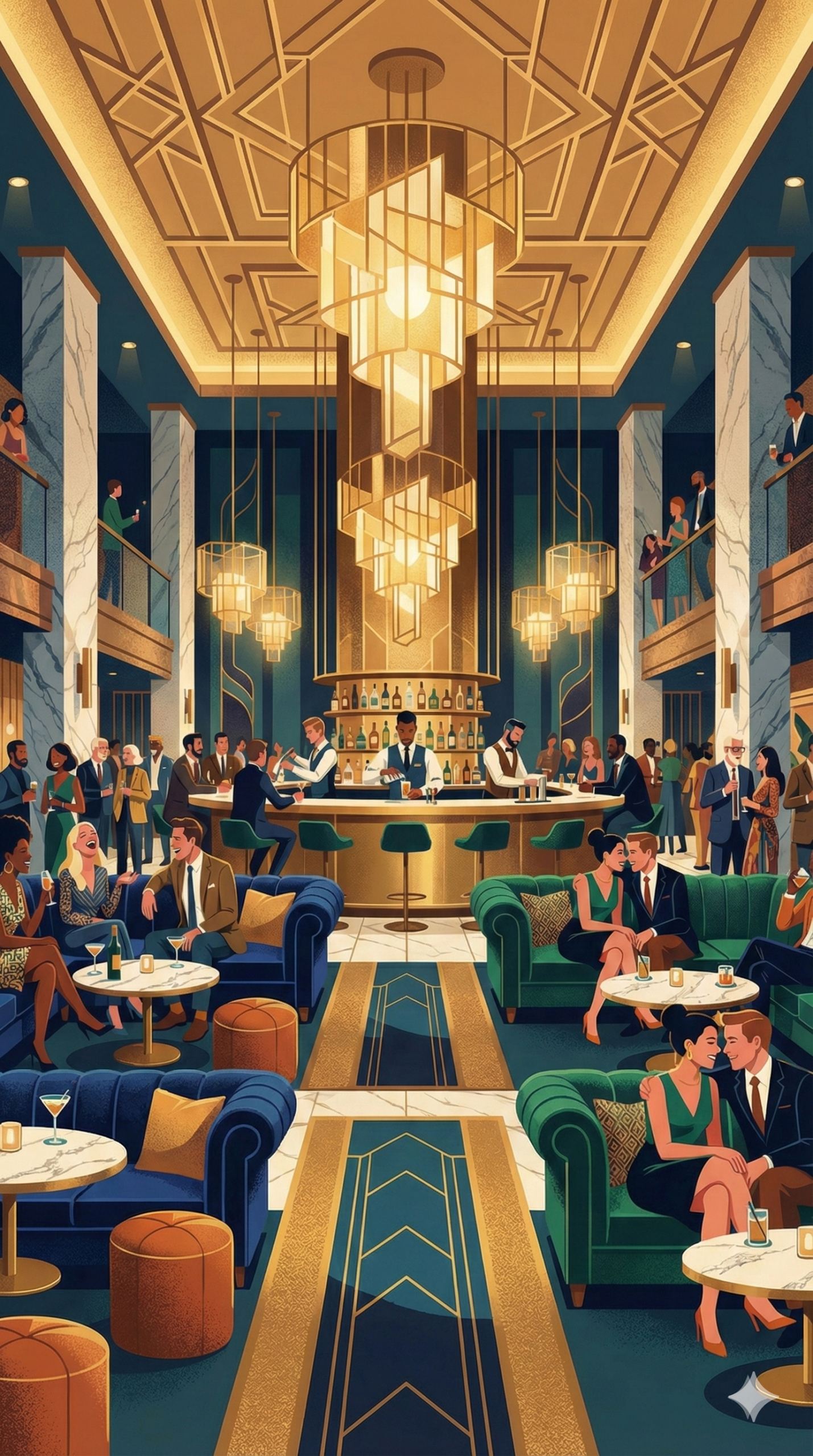
For decades, the hotel bar suffered a crisis of identity. It became a space defined by beige anonymity, an overpriced holding pen where exhausted business travelers retreated strictly out of necessity. The postwar drive for standardization had reduced what was once a bastion of social prestige to a purely functional amenity, sterilized of character and largely disconnected from the street life outside.
History, however, remembers a different standard. When Prohibition struck the United States in 1920, it inadvertently triggered a transatlantic migration of talent that reshaped hospitality. The Savoy in London welcomed figures like Harry Craddock, who codified the global cocktail canon in the Savoy Cocktail Book. Singapore’s Raffles gave birth to the Sling, while the Ritz in Paris introduced the Sidecar. In that golden age, hotel bars were not dormant waiting rooms; they were civic institutions where aristocracy, artists, and the avant-garde collided.
After a long intermission, that ambition has returned. The hotel bar has evolved from a convenience into a destination often powerful enough to eclipse the property that houses it. While New York’s Bemelmans Bar at The Carlyle remains the genre’s enduring North Star, the center of creative gravity is shifting eastward. The 2025 Forbes Travel Guide reflects this momentum, with London reinforcing its position as a global epicenter, claiming seven 5-Star accolades, the highest concentration of any capital.
Yet the energy is no longer confined to traditional powerhouses. Athens, once peripheral to the global cocktail map, has emerged as a serious contender, placing three venues in the World’s 50 Best Bars. It is not a coincidence, but part of a broader Mediterranean turn one that favors place over polish.
This new renaissance is driven by a quiet rejection of efficiency in favor of theater. At The Connaught in Mayfair, service unfolds as a choreographed performance. The Martini Trolley, an altar of black lacquer and silver does more than deliver a drink; it restores process to the experience. Bitters are measured drop by drop, not for speed but for emphasis, reminding guests that craft is inseparable from time. At Scarfes Bar in Rosewood London, the menu abandons categories altogether, unfolding instead in narrative chapters Fears, Desires, Revelations, inviting the guest to read as much as to drink.
In Athens, the same meticulousness takes a different form, rooted less in spectacle and more in provenance. At the Avra Bar in Four Seasons Astir Palace, the idea of “farm-to-glass” is taken literally: foraging expeditions across the peninsula yield pine needles, wild chamomile, and botanicals that translate the Riviera’s landscape into liquid form. At The Dolli, beneath the Acropolis, hospitality blurs deliberately into curatorship. While the rooftop offers the expected Parthenon view, the ground-floor Le Bar Secret operates as an intimate art salon, surrounding patrons with original Jean Cocteau drawings and Picasso ceramics—suggesting that fine drinking, here, cannot be separated from fine art.
Not all of this resurgence succeeds equally, and some bars mistake spectacle for substance. But at its best, the return of the hotel bar speaks directly to a shift in modern travel. We have moved beyond an era when luxury was defined by gold taps and predictable service. In a globalized landscape where high-end amenities increasingly resemble one another, the hotel bar has reclaimed its role as a civic anchor—the one space where a property’s heritage and a city’s contemporary rhythm genuinely converge.
Increasingly, the most revealing way to understand a city is no longer to walk its streets, but to take a seat at its bar.
Leave a Reply